
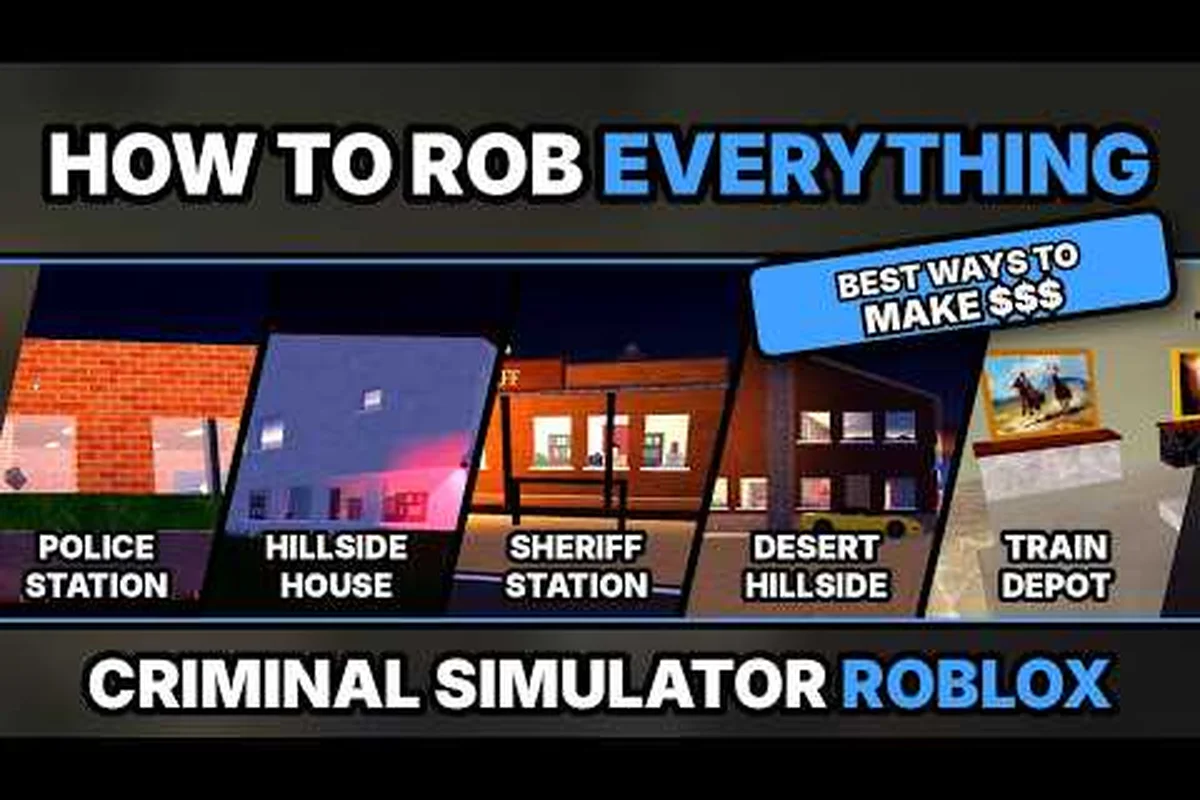
A useful criminal simulator loot guide helps you choose worthwhile houses, collect loot quickly, and reach the seller before police end the run. Learn which targets reward careful preparation and how to reduce the risk of losing everything after an arrest.
Criminal Simulator Loot Guide for Efficient Runs
Loot value alone does not determine a successful robbery. You also need a short route, a clear exit, and enough time to sell before the deadline. This criminal simulator loot guide explains how to evaluate criminal simulator house loot, compare likely targets, and build a repeatable run around the strongest balance of value and risk.
The official Criminal Simulator on Roblox page describes a night heist centered on sneaking past residents, escaping police and K9 dogs, then selling stolen goods before time expires. That structure makes route planning as important as the contents of a house. A bag full of valuables has no value if the crew is caught before reaching the seller.
Core Loot Priorities
Before choosing a target, focus on four connected factors that determine expected loot profit rather than the advertised cash value: the house’s loot density, the search footprint needed to reach each item, the noise cost of opening doors and containers, and the response window before police attention escalates. For example, three $2,000 valuables may be worth less than a single $4,000 item that sits near the exit and takes only ten seconds to collect; compare each route’s loot per house against its collection time and escape complexity before committing.
-
Sellable value: Estimate the combined worth of the items you can carry or store.
-
Collection time: Favor homes where valuables are easy to identify and reach.
-
Escape complexity: Account for doors, residents, police patrols, dogs, and distance from the exit.
-
Failure exposure: Decide whether one arrest could erase the expected profit from the run.
A strong criminal simulator loot farming route is not always the home with the highest theoretical value. It is usually the target that lets you move confidently, collect valuable items without excessive noise, and leave while the police response is still manageable.
Comparing Criminal Simulator Best Loot Spots
Because exact loot can change between houses or game versions, the safest approach is to compare locations by their practical farming value rather than assume every property pays identically. Community reports can help with patterns, but the current in-game display remains the most reliable source for each run.
The official game page supports crews of one to four players and presents police, residents, and K9 dogs as central obstacles. Those details make target selection more nuanced than simply finding the richest-looking property. A house near other activity may expose you to a fast police response, while a quieter home may require a longer approach.
| Target profile | Expected farming value | Main advantage | Main risk | Best use |
|---|---|---|---|---|
| High-value isolated home | High | Strong payout potential | Long return route | Experienced crews with a safe exit |
| Busy residential block | Medium to high | Several nearby targets | More residents and patrol overlap | Groups that can split routes |
| Nearby low-value house | Low | Fast completion and short escape | Poor profit per trip | Learning the controls or recovering from a failed run |
| Exposed commercial property | High | Potentially dense loot | Fast police escalation | Confident players with an established escape route |
| Remote property | Uncertain | More time to search | Longer travel and fewer witnesses | Crews with strong navigation and patience |
Choosing by Run State
Your best target changes with the situation. If your crew has only a short amount of time, criminal simulator loot farming should prioritize nearby homes with a simple collection path. If you have more time and a clean escape, you can consider a higher-value target farther from the seller.
Players should also account for what happens after a police encounter. The related guide to police behavior and K9 response explains why moving immediately after detection matters, while this guide focuses on reducing the chance that a single mistake turns the entire run into a loss.
Target Scoring Checklist
Use this scoring method before entering a property, since each point identifies a practical advantage for your crew. A visible sale route, concentrated house loot, an unwatched exit, and a short return path can make a property easier to loot and escape with a full bag. Covering a second route also reduces the risk of being cornered, while useful loot prevents duplicate items from wasting cargo space. Compare each answer in the checklist, then add up the points to judge whether the house is worth investigating.
| Question | Strong answer | Weak answer |
|---|---|---|
| Can the crew see a sale route? | Yes | No |
| Is the loot concentrated? | Yes | Scattered across rooms |
| Can someone watch the exit? | No | Yes |
| Is the path back short? | Yes | Long or confusing |
| Can a teammate cover another route? | Yes | Everyone follows one path |
| Is there useful loot for the current inventory? | Yes | Items duplicate weaker stock |
Assign one point for each strong answer. A score of four or five makes a house worth investigating. A score of two or three suggests using it only when better routes are unavailable. A score of zero or one is usually a poor farming target, even if the building looks impressive.
Understanding Criminal Simulator Loot Per House
A house with several visible valuables may still produce less than a smaller property with easy access to useful items. Criminal simulator loot per house is best evaluated through the final bag or storage value, not the number of objects you can see. Counters, decorations, and household items can distract from the pieces that matter most.
Building a Useful Item Inventory
Keep a simple run-by-run log of each target’s house type, item categories, approximate values, and time spent searching. For example, note whether a compact residence yielded mostly small valuables along its main path or a large residence produced high-value pieces in separate rooms. Comparing these notes across several loot farming runs reveals reliable patterns while accounting for changing house layouts and spawns, helping you improve expected earnings without assuming every house contains the same stock.
| House type | Items to prioritize | Items to skip when time is short | Why |
|---|---|---|---|
| Compact residence | Compact valuables near the main path | Small clutter spread across rooms | Fast collection reduces exposure |
| Large residence | High-value pieces in separate rooms | Low-value filler in distant rooms | Search selectively instead of clearing every room |
| Apartment target | Reachable valuables near exits | Locked or difficult-to-access rooms | Exit time matters more than perfect completeness |
| Storefront target | High-value stock near the entrance | Deep-shelf valuables | Early exits can matter more than maximum value |
Use the loot system overview when you need a closer look at item value, carrying capacity, or the relationship between stolen goods and selling them. That information turns a vague target comparison into a decision based on expected earnings.
Why Bag Space Matters
A valuable item is not useful if carrying it prevents you from taking a better item or makes movement unnecessarily slow. Treat your available capacity as part of the route plan. Compare every new piece of loot with the weakest item currently held, especially when a police response has already begun.
Instead of filling every empty slot, replace low-value cargo before searching a second wing of the house. This creates a simple rule for criminal simulator loot farming: every additional item should improve your expected payout or your ability to escape.
A Practical Inventory Decision
When the clock is getting tight, use this order of decisions: prioritize nearby high-value loot over a better payday farther inside the house, because every extra second increases the chance that a police response or a resident encounter interrupts the run. For example, if two items offer similar value, take the one reachable without crossing a risky room, then continue only if the route remains clear. This approach protects house loot and improves loot-per-house efficiency without turning a quick theft into a greedy, prolonged search.
-
Secure the closest clearly valuable item.
-
Fill space only with items that meaningfully increase the total.
-
Check the route to the exit.
-
Leave immediately if police or residents begin converging.
-
Save detailed searching for another run.
For example, if a $2,000 television sits in the next room but a $1,800 laptop is within reach, secure the laptop first; crossing the next room can trigger a police response or resident encounter, and losing the haul can erase the value of the more tempting prize. This protects total loot value per house instead of sacrificing a confirmed gain for an uncertain one.
Criminal Simulator Loot Farming Route Plan
The best route has a clear beginning, middle, and end. Start near a target with reliable loot, collect items in a controlled sweep, then sell before taking another risk. The official page highlights the need to outrun police and sell loot before the deadline, so route efficiency should be measured against both threats.
Pre-Run Planning
Before the heist begins, assign responsibilities and agree on simple signals so everyone knows what to prioritize and when to disengage. For example, use a single hand signal to warn of a patrol car, a quiet door tap to mark a searched room, and a fixed phrase for “leave the house now.” Keep the carrier’s loot-space limit in mind, since overloading it can reduce the value of a house run; clear the best loot first, then collect secondary valuables only when the route is secure. This preparation lowers the risk of losing loot when caught because the group can react to a warning before the carrier is cornered.
-
Scout: Checks the approach and identifies the most practical entry.
-
Carrier: Prioritizes the strongest loot and manages available space.
-
Watch: Tracks residents, patrol cars, and K9 movement.
-
Seller: Leads the group toward the exit once the target is cleared.
Solo players should combine these duties. Choose one exterior watch point, keep an exit route in mind, and avoid exploring rooms that cannot be reached quickly. The broader beginner guide can help with movement and core controls, but even experienced crews benefit from assigning roles.
Five-Step Farming Loop
| Step | Action | Reason it matters |
|---|---|---|
| 1. Select a target | Compare value, access, and escape distance | Prevents weak property choices |
| 2. Scout the approach | Watch residents and nearby police activity | Reveals early warning signs |
| 3. Collect selectively | Take high-value loot along the main path | Reduces time spent exposed |
| 4. Regroup and exit | Confirm every carrier is ready | Prevents one member getting separated |
| 5. Sell promptly | Turn stolen items into cash | Protects value before another encounter |
Noise and Time Management
Your route should shorten the interval between collecting loot and leaving. Avoid opening distant rooms when a strong item is already available near the exit. Likewise, do not chase a target that runs deeper into the property unless doing so provides a clear chance to escape through another opening.
The useful metric is not how many rooms you searched, but how quickly you converted risk into profit. Experienced players report that quick, decisive exits often matter more than squeezing one extra small item from a dangerous room. Treat that as community advice that may change with patches, and prioritize the behavior visible in your current session.
Preventing Criminal Simulator Losing Loot When Caught
Arrest is the defining failure state of a run, and preparation is the best protection. Knowing exactly how your crew reacts can help you decide when to continue and when to abandon the target. The guide to escaping police and their dogs adds more detail on evasion, while the key loot principle is simpler: reduce exposure before the catch.
Before an Encounter
The best response begins before police enter the house: scan the house loot layout, identify the highest-value drawers or containers, and plan a short extraction route through the expected police entry point. For example, if the front door is likely to be breached first, prioritize nearby valuables before moving deeper into the property. This reduces the number of rooms crossed after the encounter starts and helps preserve more house loot in a successful loot farming run.
-
Keep all exits visible and avoid allowing a single door to block the retreat.
-
Keep one crew member focused on movement rather than loot.
-
Stop collecting when the escape window begins to close.
-
Avoid splitting across distant floors or properties.
-
Preserve enough route knowledge to leave without searching for the entrance again.
These habits turn criminal simulator losing loot when caught from a surprise into a manageable risk. For example, if the crew has already looted the high-value house loot drawers but police breach the front entrance, the designated lookout can trigger an immediate retreat while another player secures the remaining valuables near the exit. More importantly, leaving the property before police make contact preserves the entire run’s haul instead of forcing a failed escape that turns every collected item into potential loss.
After the First Alarm
When detection occurs, separate the crew’s priorities by assigning roles instead of having every thief react independently. For example, the carrier should protect the highest-value house loot while a lookout tracks police response and nearby alerted residents; a quick scan of the house’s exit options can prevent the crew from crowding the same hallway. This matters because a blocked route can turn a recoverable robbery into a failed loot run, especially when valuable items are still being carried.
| Priority | Action | Avoid |
|---|---|---|
| 1 | Identify the nearest viable exit | Running blindly through rooms |
| 2 | Keep carrier and watch together | Leaving valuable loot unattended |
| 3 | Move away from the alarm source | Circling back to the same target |
| 4 | Break line of sight in a safe area | Stopping to collect one more item |
| 5 | Reach the seller if possible | Splitting up for individual loot |
Do not reverse direction just because the original route is blocked. A longer but open route may be safer than sprinting back toward alerted residents. This is also where knowledge of the police response and chase mechanics becomes valuable: identify the threat, create distance, and commit to an escape rather than improvising in place.
Leave While the Larger Haul Survives
Abandoning a target is not failure if it protects the larger haul. Leave immediately when a long pursuit begins, the crew becomes separated, or the only remaining route crosses a heavily alerted area. The objective is to preserve value, not to complete every room.
If the game’s current rules apply an arrest penalty, assume that a caught carrier may lose carried loot. That does not mean every route is equally dangerous. Houses close to the seller, targets with short exits, and crews that collect only the most valuable items all reduce the number of decisions available to police.
Turning Loot Into Reliable Income
Selling is not the finish of the strategy; it is the point where risk becomes progression. A criminal simulator loot guide is only useful when its recommendations improve your actual income after fees, time, and failures are considered. Use the related money-making guide to connect loot value with the wider economy.
Measuring a Farming Session
Track four numbers after each run, then compare the results with a simple efficiency ratio: cash received divided by time spent. For example, three nearby house loot runs might earn 3,000 in 18 minutes, while one distant run could earn 1,200 in 15 minutes because the route adds travel time. Also log loot abandoned after police encounters and whether the bag fills before the exit; these details reveal whether low earnings come from weak targets, long travel, poor bag management, or an inefficient escape plan.
-
Cash received: The amount actually earned from sold loot.
-
Time spent: Total time from start to sale.
-
Items abandoned: Loot left behind because of police or route changes.
-
Runs completed: The number of successful or failed attempts.
| Session pattern | Likely issue | Recommended adjustment |
|---|---|---|
| High cash, long time | Route or collection is inefficient | Target closer homes and leave earlier |
| Low cash, short time | Target value is too low | Improve item selection before extending the route |
| Strong first run, weak later runs | Police response is escalating | Change targets and learn new exits |
| Frequent arrests | Escape plan is weak | Scout first and assign a dedicated watcher |
| Bags fill quickly | Capacity management is poor | Replace weak items instead of searching farther |
Comparing Two Farming Styles
| Style | Best target | Advantage | Limitation |
|---|---|---|---|
| Speed farming | Nearby, easy-to-clear house | Quick sales and short exposure | Lower value per run |
| Value farming | Richer house with reliable access | Higher payout potential | More time and stronger police response |
| Group farming | Several nearby homes | Flexible routing and shared cover | Requires coordination |
| Solo farming | Simple property near the exit | Fewer coordination mistakes | Limited carrying and backup |
A mixed strategy works well for many players. Use speed targets to learn the city and build a little cash, then shift to value targets when you understand where police and dogs tend to appear. The official page describes the game as an alpha experience, so patterns may change as the release develops.
Common Loot Mistakes and Better Alternatives
Most wasted runs come from decisions that look productive while they actually reduce your loot value. For example, repeatedly forcing a low-value house loot spot instead of checking nearby alternatives, or chasing one container until an escape route becomes unsafe, can turn a clean run into a loss. In a criminal simulator loot guide, efficiency means comparing house loot per trip, preserving escape space, and abandoning marginal searches before a catch risk forces you to drop accumulated loot. Correcting these small judgment calls makes criminal simulator loot farming more consistent without requiring unrealistic perfect play.
Mistakes to Avoid
| Common mistake | Why it hurts | Better alternative |
|---|---|---|
| Searching every room | Extends exposure and delays the exit | Prioritize the clearest path |
| Chasing the police | Creates unpredictable contact | Break away and preserve distance |
| Ignoring bag capacity | Low-value cargo can block better loot | Replace weaker items |
| Repeating one route | Police response becomes predictable | Rotate targets and exits |
| Starting far from the seller | A chase becomes expensive | Begin with a nearer property |
| Splitting the crew | Members become isolated | Keep the group connected |
| Selling late | Leaves no margin for another issue | Leave and sell promptly |
The most common error is treating loot collection as a checklist rather than a timed sequence. Each additional item should have a clear benefit and a short route to the exit. If it does not, skipping it can be the profitable choice.
Practice Routine
Run several low-risk house heists and improve one loot mechanic at a time, such as identifying valuables, carrying capacity, or replacement cargo. Compare each run by house type, entry route, and final sale value; for example, record whether a low-value item was worth the risk of leaving a stronger item behind. This creates a repeatable loot-farming routine and helps separate reliable house loot from items lost when caught.
-
Memorize the nearest exit from two common house types.
-
Time a clean trip from entry to seller.
-
Practice replacing weak cargo instead of filling every slot.
-
Watch how residents react after the first alarm.
-
Note where police and dogs become visible.
-
Review whether each route ended with a sale or an escape.
This routine turns the best loot spots into a personal route plan. Community guides such as Blueburry’s Criminal Simulator weapons, money, and upgrades video can support early-game learning, but current in-game testing remains the best way to confirm loot behavior.
Frequently Asked Questions
What are the best loot spots in Criminal Simulator?
The best loot spots are usually homes that combine worthwhile valuables with short access to an exit. Check the current house contents, resident activity, and nearby police before committing. A slightly less valuable target can produce better income if it lets you collect and sell faster without losing the entire bag.
How do I farm loot efficiently in Criminal Simulator?
Choose one nearby target, scout its approach, collect the strongest items along the main route, and leave before police close the exit. Efficient criminal simulator loot farming is not about clearing every room; it is about converting available time into a safe sale while keeping your crew together.
Do I lose all loot when caught by police?
A caught carrier can lose carried loot, but exact consequences may depend on the current game version. Treat criminal simulator losing loot when caught as a serious possibility. Reduce risk by collecting less, keeping an exit open, tracking police movement, and abandoning a bad route before contact occurs.
Should every crew member search the same house?
No. Splitting by floor can help with larger properties, but excessive distance creates capture risk. A better setup gives one player a watch role, assigns collection priorities, and keeps everyone close enough to regroup. Agree on an exit and departure signal before the crew becomes separated.
How many valuables should I take from one house?
Take enough to make the trip worthwhile without filling capacity with weak items. If a new item barely improves your total, skipping it may be safer. The best cargo is valuable, easy to carry, and located close to the route you will use to reach the seller.