
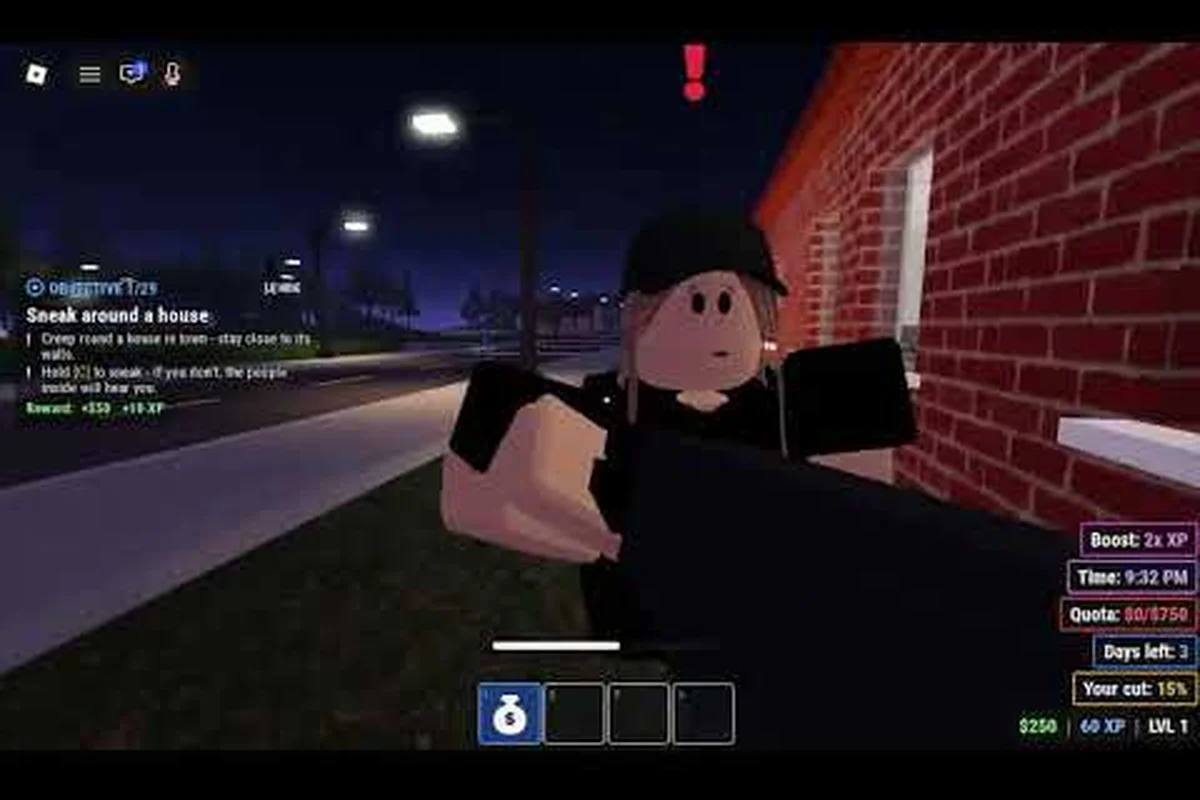
Criminal simulator co-op runs succeed when the crew assigns roles, limits distractions, and treats every robbery as a timed escape. The official Criminal Simulator on Roblox supports crews of one to four, making small-team coordination essential for snagging loot without being caught by police or K9 units.
Criminal Simulator Co-op Run Roles and Planning
A strong criminal simulator team up begins before anyone enters a property. Each player should own a clear responsibility, while the group agrees on when to enter, where to meet after a distraction, and what constitutes an immediate retreat. That small planning step prevents the most common failure mode: four players moving independently, collecting loot at different speeds, and splitting up when police arrive.
Nighttime robberies form the core criminal simulator co-op run loop: enter a building, secure valuables, avoid residents and police, then return to the drop-off before the deadline. A missed alarm, a trapped teammate, or a failed escape can force the crew to abandon the haul, so communication should track both objectives and escape readiness. For example, the scout can mark a dangerous entrance while the distraction creates a route for the loot carrier; if police close in, the escape lead can redirect everyone before the sale becomes impossible.
| Role | Main responsibility | Best action under pressure |
|---|---|---|
| Scout | Checks entrances, cameras, residents, and escape routes | Marks danger and redirects the crew |
| Loot carrier | Handles valuables and prioritizes high-value objectives | Keeps moving unless the route is blocked |
| Distraction | Draws attention away from teammates | Creates space without wandering too far |
| Escape lead | Watches police, K9 units, and the clock | Calls the retreat and protects the exit |
Assign Roles by Crew Size
For a two-player crew, combine the scout and escape lead into one role while the other acts as the loot carrier. A three-player crew can dedicate one player to distraction without abandoning the exit. In a four-player crew, every function should have an owner, but the escape lead still needs final authority over retreat decisions.
The best criminal simulator co op tips are simple rules that everyone remembers and applies under pressure. In a two-player run, use the scout’s route knowledge to guide the loot carrier toward the collection point, then switch to escape-lead duties before police alerts trigger. With three or four players, preserve one clear chain of responsibility: entry, objective interaction, distraction, and retreat. If roles blur during a police response, the escape lead should issue one final direction rather than let each teammate choose a different exit.
-
Stay within sight range whenever possible.
-
Call out doors, windows, residents, and police.
-
Do not loot an objective alone if someone can watch your back.
-
Set a collection point away from the first entrance.
-
Abandon optional loot when the timer or police pressure becomes critical.
-
Leave together instead of making a lone escape attempt.
Communication should describe what a teammate needs to know, not merely announce visible action. “Police behind you” helps far more than “I see something,” and “Meet by the east exit” gives the group a concrete destination. Players who dislike constant voice chat can still use short, consistent callouts or shared map awareness.
Set a collection point before entering
The collection point is the crew’s safe transfer zone, where a teammate can watch the route while another finishes looting. It should be easy to describe, remain reachable, and sit away from the most obvious entrance. A narrow alley may offer cover, but it can also become a trap if police block the only exit.
The crew strategy overview explains how crew size affects communication and shared objectives. Use that structure to decide whether the run needs everyone inside the building or whether one player should remain outside as a lookout.
| Crew size | Recommended setup | Main advantage | Main risk |
|---|---|---|---|
| Solo | Scout, loot, escape | Full control of every decision | Attention is divided constantly |
| Duo | Recon plus looting | Simple coordination | One distraction can expose both players |
| Trio | Recon, loot, escape | Better route coverage | Unclear ownership may slow looting |
| Quad | Recon, loot, distraction, escape | Strongest pressure handling | Conflicting orders become costly |
Criminal Simulator Co-op Tips for Stealthy Entries
The best entry is the one that lets the crew predict where danger will appear. Before entering, check the approach for residents, visible cameras, patrol routes, and the nearest path back to safety. The goal is not to memorize every street; it is to identify one credible entry and one dependable escape route.
Separate movement from looting
Movement roles should move as a unit until the group reaches a safe interior area. Looting roles can then split for no more than a few seconds. Constantly crossing paths creates noise, collisions, and confusion, especially when someone is carrying valuable loot.
A practical entry sequence looks like this: first, use the exterior sightlines and escape options during recon, then move the crew as a single unit toward the first objective. Treat the entry phase as a short exposure window rather than an invitation to explore every room; the table’s 10–15% allocation is more useful when nobody pauses mid-route to loot. Once inside, split into paired lanes for the 40–50% looting phase, but keep each pair close enough to support the other. Regroup before escape, because pursuit and the deadline can turn a late detour into a failed payout even if the crew has secured valuable loot.
| Phase | Time allocation | Crew action | Reason it works |
|---|---|---|---|
| Recon | 15–25% | Inspect the exterior and escape options | Prevents the crew from entering a dead end |
| Entry | 10–15% | Move together toward the first objective | Limits early exposure |
| Looting | 40–50% | Split into paired lanes | Doubles coverage without losing support |
| Escape | 25–30% | Regroup and move toward the exit | Accounts for pursuit and the deadline |
These are community-tested planning ranges rather than guaranteed safe windows, so police response times may vary by build. The useful principle is to leave with enough time to react. A crew that spends nearly the entire deadline searching for one more valuable item has turned a profitable robbery into a failed payout.
Control doorways and sightlines
Doorways create bottlenecks because only one player can pass comfortably at a time. Assign a teammate to check through the doorway before the carrier enters. Keep the rest of the crew slightly back, which creates staging distance and prevents everyone from crowding around a suspicious resident.
Inside, avoid crossing directly in front of windows. Move along interior walls where possible, and use furniture or corners as temporary sight blockers. If a teammate spots danger, the scout should indicate the safe direction rather than pulling the group into an uncertain corner.
Players who want more foundational advice can compare the beginner tips and common mistakes before attempting a difficult property. The most transferable habit is to keep your view moving: check behind you, listen for pursuit, and never assume the last visible police officer was the only one.
Managing Police, K9 Units, and Escape Routes
Police pressure is where many criminal simulator co op challenges become dangerous. A crew can finish a robbery and still lose the payout if it cannot leave cleanly. Treat escape as an active phase of the heist rather than something that begins only after the final item is collected.
Use layered distractions
The strongest distraction has two layers. First, it moves immediate attention away from the crew. Second, it buys enough time to reach a prepared route. Simply running in a circle can waste the distraction, while moving behind a teammate creates confusion that the group can use.
Useful two-stage distraction methods rely on splitting attention across separate crew roles: one player creates a visible or audible incident to draw police, K9 units, or residents toward a controlled point, while the carrier uses the opening to reach a prepared route. For example, a teammate can trigger a noisy storefront event as the carrier slips through a nearby alley toward the getaway vehicle. The key is timing rather than distance: if the distraction ends before the carrier clears the entrance, the officers may reverse direction and intercept the escape route.
-
Creating noise near one entrance while the carrier approaches another.
-
Having the scout watch police while the distraction draws attention toward a safe, non-loot area.
-
Using an alternate route once residents or officers focus on the first disturbance.
-
Stopping immediately if the distraction creates a new patrol path toward the exit.
Because police and K9 units can follow movement, the group should not depend on one player permanently holding a pursuer. That player still needs a safe fallback, and the crew needs enough separation to avoid pulling every officer into a single corridor.
Keep a route-open rule
Before anyone enters a room, identify the exit that remains usable if the room becomes blocked. This does not require perfect predictions, because police behavior may vary with the current version or server. It simply prevents the team from moving deeper into a space without confirming a path back.
| Situation | Poor response | Better crew response |
|---|---|---|
| One officer appears | Everyone rushes the same door | One player distracts while another checks the second exit |
| K9 unit approaches | Loot carrier continues looting | Carrier holds valuables and follows the planned retreat |
| Main exit is watched | Crew seeks nearby rooms at random | Scout checks for an alternate route while others wait |
| Timer becomes urgent | Crew splits to collect everything | Everyone leaves optional loot and regroups |
| Player is separated | Teammates continue without checking | One player holds a safe route while another reconnects |
This approach improves criminal simulator co op mode performance because the crew preserves options instead of reacting only to the nearest threat. If the group is playing on PC, assign the player with the clearest view to manage route decisions while the others focus on carrying valuables and covering movement.
Loot Decisions That Protect the Whole Crew
Looting is the scoring engine of a run, but it should never outweigh survival. A crew that loses everything because one player chased a rare item at the final moment did not earn a better heist; it simply created a more expensive mistake. For broader item-handling advice, review the loot planning and selling guide.
Use a value threshold, not a value obsession
Agree on a minimum value that justifies the extra travel and risk. For example, a crew may decide that an item is worth delaying the exit only when its value compensates for the route, detection risk, and remaining time. The exact threshold should reflect the property and current situation rather than a universal number.
| Loot decision | Continue collecting | Leave immediately |
|---|---|---|
| High-value item, clear path | Collect if the timer allows | Do not detour for a side room |
| Moderate item, police nearby | Only when the exit remains open | Prioritize escape |
| Low-value item, long route | Usually skip it | Keep the schedule intact |
| Required-looking objective | Confirm before collecting | Follow the crew rule if uncertain |
Prevent accidental drops
A common mistake is assuming everyone knows which item is being carried, where it goes, and who must deliver it. Assign loot custody clearly: one carrier holds the main haul, one teammate carries a backup item, and the escape lead keeps inventory space ready for quick transfer.
Callouts should use simple categories rather than vague warnings. “I have the big item” is more useful than “I’m holding it,” while “I lost the small one” alerts the group to check the route. If a valuable item is dropped, the crew should decide immediately whether recovering it is safer than the remaining payout.
Balance greed against the deadline
Every extra pickup creates a compound decision because it also adds carrying time, route pressure, and a larger reason for police to pursue the crew. A clean escape can be worth more than another indoor item. The best criminal simulator co op runs therefore define a stopping threshold before adrenaline takes over.
| Crew condition | Recommended behavior |
|---|---|
| No police nearby and timer is comfortable | Collect a short bonus route |
| One teammate is separated | Stop optional looting |
| Police are inside the property | Complete only the nearest objective |
| K9 unit is tracking the crew | Head for the exit with the safest path |
| Timer is below the planned escape allowance | Abandon optional loot immediately |
The practical result is less loot in some criminal simulator co op runs but far greater consistency. A repeatable payout lets the crew bank cash after the first successful heist, then use those funds for armor, vehicles, or tool upgrades before attempting a higher-risk robbery. For example, if one run yields enough income to cover the next planned upgrade, the team can reject an extra pickup when police are already inside the property and preserve a safe escape route. That trade-off keeps later escape allowances predictable, reduces failed runs, and prevents a single police chase from wiping out the crew’s accumulated progress.
Criminal Simulator Team Up Communication and Recovery
Even a capable crew can recover from mistakes if everyone understands the recovery plan. The most common communication errors are speaking over each other, giving contradictory directions, and making every detour sound urgent. A compact callout system keeps important information audible.
Use four callout categories
A workable communication system does not require specialized terminology. Players can use contact, direction, objective, and retreat messages to coordinate a criminal simulator co op run. A complete callout names the threat or target, gives its location, and states the next action: for example, “Contact—resident left, hold,” “Direction—police from the street, use the back exit,” or “Objective—big item upstairs, send the carrier.” This structure helps teammates react before entering a room, reduces hesitation during a police response, and keeps the loot carrier focused on protecting the haul.
| Callout type | Example | Immediate team response |
|---|---|---|
| Contact | “Resident to the left” | Hold movement or redirect |
| Direction | “Police coming from the street” | Choose the alternate exit |
| Objective | “Big item is upstairs” | Assign a carrier and a lookout |
| Retreat | “Leave now, east route” | Stop looting and regroup |
Keep callouts short because a crowded property can make unnecessary conversation confusing. If one player is carrying loot, they should focus on movement and warning teammates rather than initiating every route decision. The escape lead can call the final retreat while the carrier protects the haul.
Regroup after every major objective
After collecting a high-value item, returning a dropped item, or leaving one section of a property, the crew should briefly reconnect before continuing. This is not a full meeting; it is a two-second visual check that confirms all players can see the group marker and that the next route is clear.
The robbery playthrough can help with property sequencing, while the co-op communication section should govern how the team handles every room and corner. If a teammate is missing, the group should not scatter blindly. One player can hold a safe exit while another follows the last known route.
Practice scenarios instead of memorizing one route
Every criminal simulator co op run is different because police, residents, and loot placement can change. A crew that memorizes one successful robbery may fail when the entrance door is occupied or the preferred escape route becomes blocked. Practice the decision process instead.
Useful scenarios to rehearse include each decision point in a criminal simulator co op run: choosing an entry point, deciding whether a target remains worth looting, and managing the route back to the collection point. For example, if a crew finds the normal entrance occupied, it can compare the extra time required by a secondary route with the risk of triggering a police encounter. This builds the decision process needed for criminal simulator team up runs instead of relying on one memorized robbery.
-
Entering through the secondary route when the normal entrance is watched.
-
Abandoning a target after a teammate spots a police officer.
-
Separating into two pairs and reconnecting at the collection point.
-
Recovering a dropped item without delaying the entire crew.
-
Leaving immediately when the timer drops below the escape reserve.
-
Helping a teammate who has been separated from the group.
Community reports often describe successful crews as those that move deliberately and communicate early. That observation fits the official structure of the game: the police encounter, K9 pursuit, and deadline remain central pressures, so a flexible plan is safer than memorized choreography.
Advanced Criminal Simulator Co-op Run Improvements
After the crew can complete a robbery without obvious confusion, improve the run by measuring outcomes. The best metric is not merely the biggest loot total; it is the amount of profit retained after time, failed attempts, and recovery delays. A dependable medium-value heist is often more valuable than an ambitious heist that ends in capture.
Audit the final five minutes
Review what happened from the last objective to the exit, marking the exact moment when the crew stopped progressing efficiently. Treat the timeline like a heist post-run debrief: note who carried the haul, who handled distractions, and when the escape lead gave the route. For example, if looting continued for more than a minute after the escape reserve was spent, flag the overextension; if teammates stopped moving at the same doorway, identify the pathfinder failure rather than blaming slower movement. Common audit findings include:
-
The group delayed after collecting because nobody owned the next route.
-
Both teammates blocked the same doorway while the carrier waited.
-
A distraction began too late to help with the intended exit.
-
Players scattered after a drop instead of protecting the main haul.
-
The crew collected optional loot after the escape reserve had already been spent.
| Audit finding | Correction for the next run |
|---|---|
| Unclear loot ownership | Name the carrier before entering the room |
| Late distraction | Set the trigger before the carrier reaches the target |
| Doorway congestion | Keep a dedicated pathfinder near the exit |
| Disputed route | Let the escape lead make the final call |
| Repeated overextension | Define a hard “leave now” condition |
Tune the crew for the objective
A duo should favor simple, legible routes. A trio can safely use a short split, such as one player scouting while two loot. A four-person crew has the greatest ability to create distractions, yet it also needs the strictest role boundaries. The PC and platform overview includes related information about supported play arrangements, although the core rule remains unchanged: every member should have a visible purpose.
When a challenge repeatedly fails, simplify rather than adding more improvisation. Remove optional objectives, reduce the loot target, or move the collection point closer to the exit. Once the crew can finish reliably, restore one layer of complexity at a time.
Preserve the final escape reserve
The escape reserve is the portion of the run reserved for leaving, not looting. Its length depends on the property, crew size, and expected pursuit. Rather than assigning a precise universal number, the team can judge it by its hardest likely route: if the slowest member cannot leave comfortably within that reserve, the group is overextending.
This final check also reduces frustration. Players feel more confident when everyone understands that leaving early is a valid success, not failure. A criminal simulator team up that reaches the sale point with a smaller haul can still build stronger progression than one that chases a perfect score and loses everything.
Frequently Asked Questions
Can Criminal Simulator be played with friends on Roblox?
Yes. The official Roblox listing identifies Criminal Simulator as a night-heist experience that supports crews of one to four players. For the clearest setup, join the same server, group before entering a robbery, and assign separate roles so each teammate knows what to monitor.
What is the best strategy for Criminal Simulator co-op runs?
The strongest strategy is to define roles, select an entry and escape route, collect nearby valuables, and regroup before leaving. Avoid splitting into isolated routes because police and K9 units can punish scattered movement. Set a leave-now condition before the deadline becomes urgent.
Should every teammate loot during a robbery?
Not always. One or two players should handle valuables while the others watch doors, residents, and police. If everybody loots independently, nobody may protect the carrier or notice an approaching officer. Reassign roles whenever the group enters a new section of a property.
How do co-op players deal with police and K9 units?
Create a distraction, keep one route open, and move toward an alternate exit. Do not rely on a teammate to hold a pursuer forever, because police paths and K9 tracking can change the situation. The crew should protect the main haul and leave optional loot behind when pursuit increases.
Is Criminal Simulator available for co-op on PC?
Yes, Roblox supports Criminal Simulator on PC through the official game page. Your PC performance and controls may vary by device and setup, so test a short run first. The essential preparation is stable communication and a simple plan that all crew members understand.